Betterment Review: A Closer Look at Investing with Betterment
Betterment.com. Perhaps you’ve heard of this new investing website and are wondering if it’s right for you. In this review we’ll explore investing with Betterment and explain performance, fees, and give you our bottom line opinion.

What is Betterment?
One of the main objections I’ve heard to investing is that it is complicated. Truly, there is a lot to learn if you’re going to make a profit investing – whether it’s for retirement or simply to accumulate wealth. Betterment seeks to simply investing by recommending an asset allocation based on your answers to a few questions regarding your investment goals.
Some of these questions include:
- What are your investing goals? Retirement? College? A new house?
- When do you want to reach your investing goals? 5 years? 10 years? 40 years?
- How much money would you like to end up with?
Your answers to these questions will result in a recommended allocation of bonds and stocks. Bonds are typically stable investments but have low returns while stocks are more volatile but usually have higher returns. These bonds and stocks are contained within ETFs (exchange-traded funds) that are traded much like regular stocks. The result of this strategy is that you’d have a well-diversified portfolio customized to your investing goals.
The Betterment Experience Reviewed
For this Betterment review, a representative sent me a link to a free demo account so that I could show you how Betterment works and how easy it is to use. Simply put, I found the user interface to be refreshing and should be the standard for how other investing firms design their website experience.
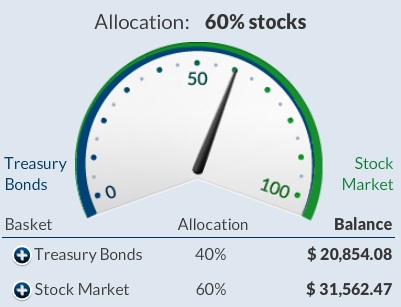
Take for example their allocation indicator. Reminiscent of a speedometer, you can see very clearly how aggressive your portfolio is positioned. If the gauge is pointing more to the stock market side, you know you have the potential to make a higher return but also are at risk of losing more money.
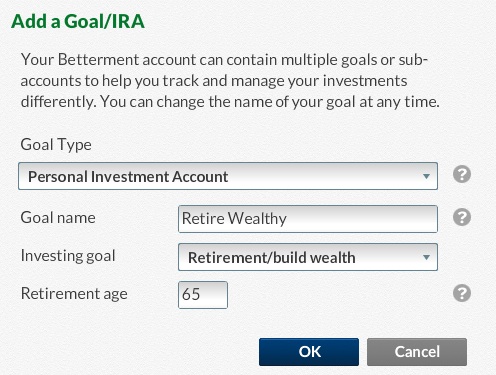
After you set up your account, you can easily select new investing goals. Some of your options include retirement, building wealth, major purchases, college education, wedding, vacation, kids/baby, rainy day (emergency fund), or other general purposes. The only one of these categories I’d object to is the rainy day fund, as I believe that emergency funds should not be in potentially volatile investment accounts.
In addition, you can add Traditional or Roth IRA accounts in Betterment. Choosing the Roth IRA option will give you the highest returns in the long run, but will cost you the most money upfront (as your invested money is not tax deductible in the year you invest it).
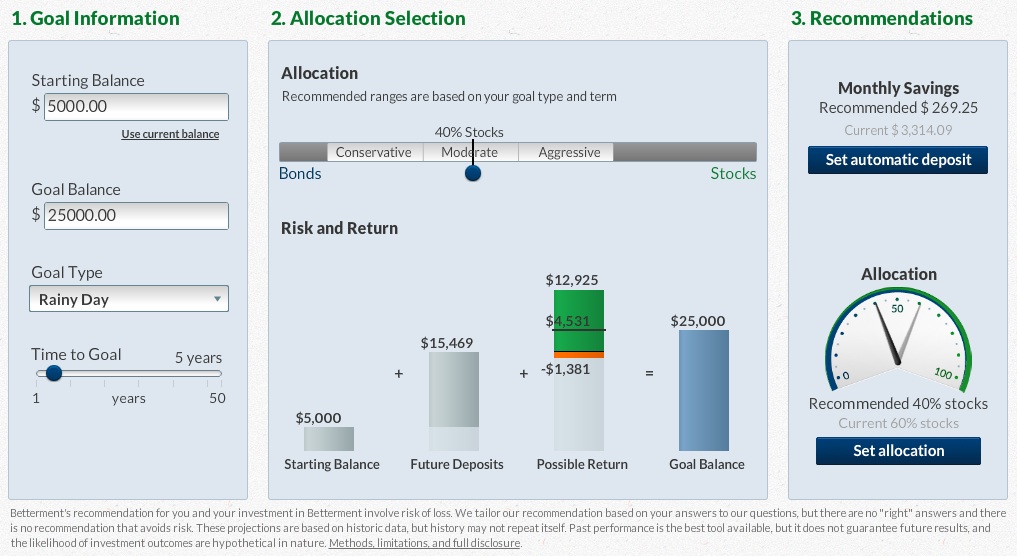
A very handy feature is Betterment’s allocation graph that shows you your potential gains over time. Simply set how long you’re going to invest, what you want your allocation to be between stocks and bonds, and you’ll see how much money you’re likely to have at the end of your investing term. This allows you to quickly see how much progress you can make over time.

While Betterment.com seeks to simply investing, you should know that it also has some more in-depth analysis available to view. You can see your account activity and performance with a few clicks. You can also get advice and recommendations for each of your individual investing goals (not merely a generalized plan).
Betterment Fees
A review of Betterment wouldn’t be complete with explaining the fees. Fancy graphics and easy-to-use sliders/buttons are nice, but what about the fees? How does Betterment compare with other options?
The majority of first time investors will be charged an annual 0.35% fee (those with less than $10,000 to invest) and you must invest at least $100 per month. If you have over $10,000 to invest, your fee will be reduced to 0.25% with no minimum. And, if you have over $100,000 to invest, you’ll get a very low 0.15% fee plus a customized investment plan by CEO Jon Stein.
How does Betterment compare? Here is a biased (yet humorous) chart:
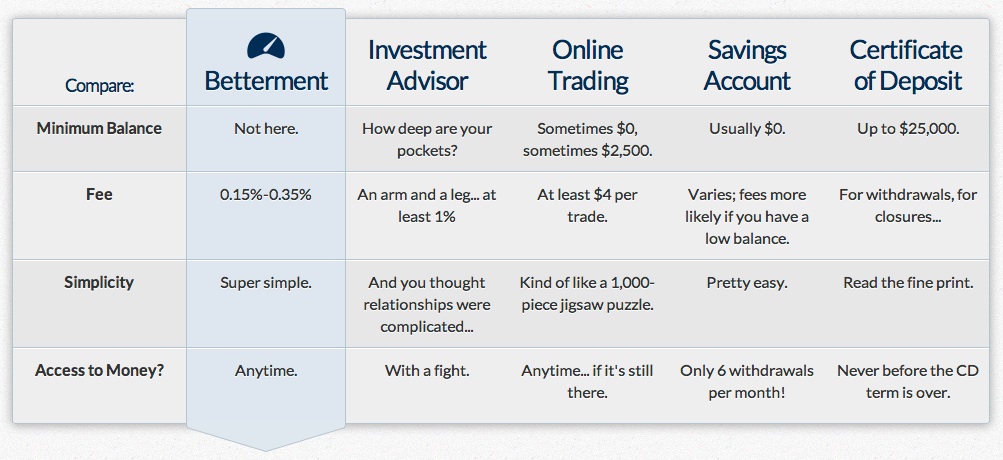
The thing about fees is that they don’t tell the whole story. While an investment advisor might charge you more than investing with Betterment, you’ll also get a personalized face-to-face investing recommendation no matter how much money you’re investing. With an investment advisor or online trading, you’ll also get more investing options such as the ability to use mutual funds to potentially get higher returns. However, more options complicates things and makes investors less likely to, well, invest.
Betterment Performance and Returns
Betterment boasts an average annual return of 7.86%. That’s not bad compared to many other places you could put your money. However, Dave Ramsey claims that you can find mutual funds that average 12% returns over a 10-year period of time. In order to achieve these high returns, you have to be intimately involved with your portfolio and work with an investment advisor who knows their stuff. Not everyone has time for that, but they should make the time if they want to get the highest possible returns.
Betterment claims that the typical, non-Betterment investor makes an average annual return of 3.46%. Obviously, Betterment blows this figure out of the water with their returns.
The Bottom Line
Betterment offers a simple investing solution for those who don’t want to spend the time researching the complexities of investing. Betterment offers a pretty reasonable rate of return and keeps your money liquid so you can take it out when you need it.
I’d recommend Betterment for anyone who is paralyzed by the complexity of investing and wants to keep things super simple. I believe that Betterment will also encourage people to take action and save money while earning a decent return on their investments.
Sound like Betterment is a good fit for you? Get a $25 signup bonus or check out their website for more information. It’s certainly worth looking into!
What do you think about Betterment? Anything else we should have covered in this review? How do you like to invest? Leave a comment below!

Leave a Reply
Want to join the discussion?Feel free to contribute!